


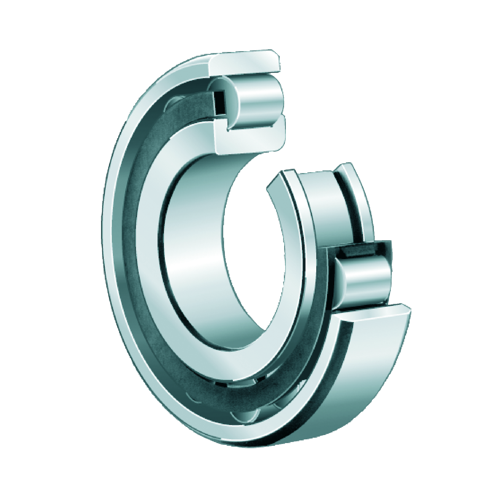

A cylindrical roller bearing is a rolling-element bearing designed to carry high radial loads with low friction. Instead of balls, it uses cylindrical rollers which create a larger contact area with the raceways, giving higher load capacity and rigidity.
They consist of an inner ring, outer ring, cylindrical rollers, and a cage that spaces the rollers evenly. Depending on the design, one ring may have flanges while the other is free, allowing axial movement of the shaft. This makes certain types ideal for accommodating thermal expansion without inducing stress.
Different configurations define how axial load is handled:
N / NU types allow axial displacement in both directions
NJ types allow axial location in one direction
NUP types allow axial location in both directions
Alongside metric designations, cylindrical roller bearings are also commonly referenced in imperial series, particularly in older or legacy applications:
LRJ – Light series cylindrical roller bearing
MRJ – Medium series cylindrical roller bearing
LLRJ – Extra light series cylindrical roller bearing
These imperial references generally relate to the bearing’s cross-section and load capacity within inch-based shaft sizes.
Cylindrical roller bearings are widely used in electric motors, gearboxes, pumps, and automotive or autosport applications where high radial loads and reliable performance are critical. They are typically manufactured from high-grade bearing steel, with options for specialised heat treatments or coatings depending on operating conditions.